Wake

What you really earn when you copy a trader

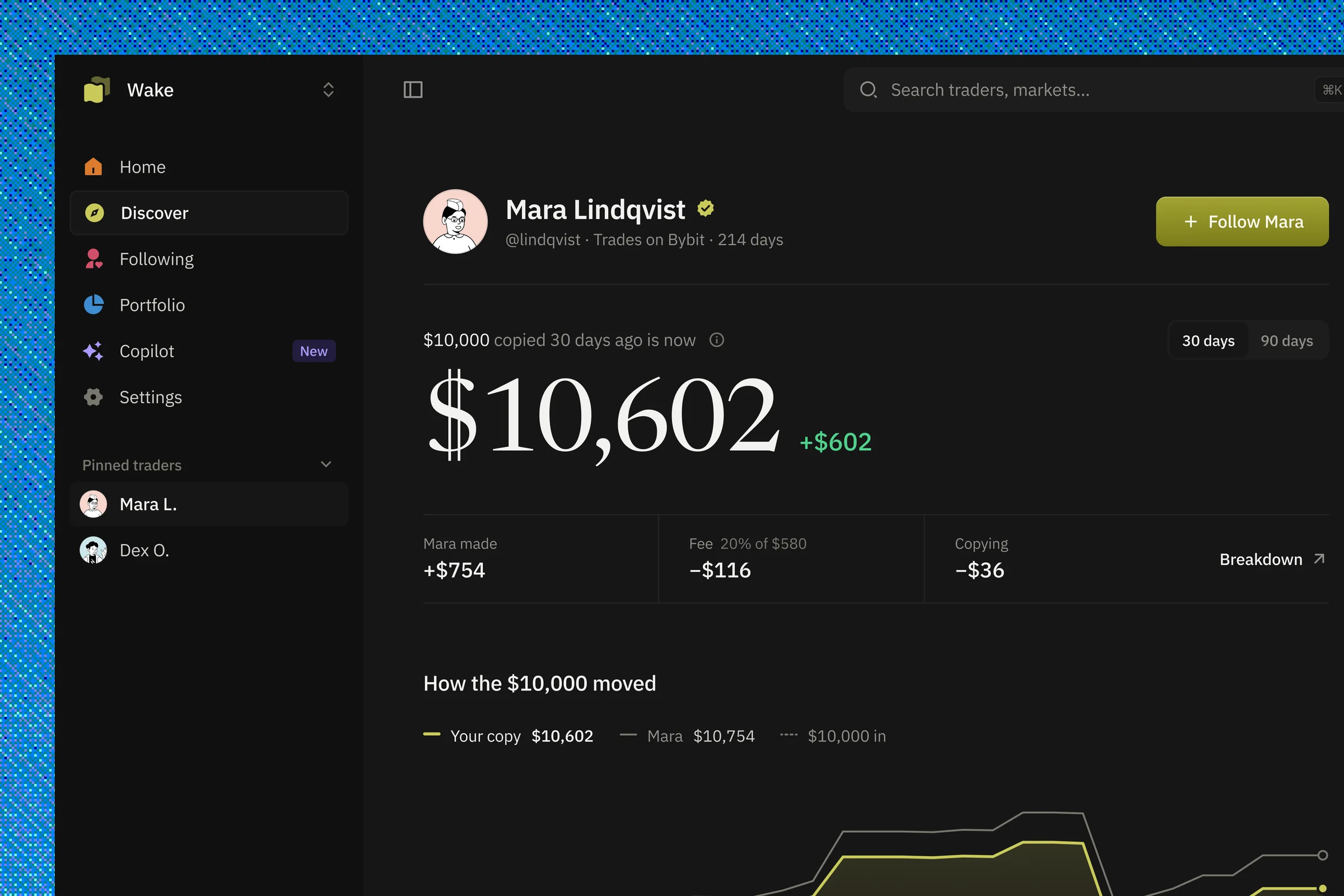
Copy trading lets you copy another trader’s moves with your own money. Apps show how much the trader made, but you always make a bit less. Wake is a trader page that shows what you would have made, and where the rest went. By Birthright Ntuk.

Open the prototype

Role
Design and code
Pages
Trader page, breakdown, follow
Tools
Figma, Next.js, Tailwind v4, Motion
Status
Concept, made-up data
Open the prototype: Wake trader profile, $10,000 copied 30 days ago is now $10,602

The problem

Copy trading apps show the trader’s profit. But when you copy a trader, you don’t get the same profit. You pay the trader a fee. Your orders go in a moment after theirs, at a slightly worse price. And your order sizes get rounded down. So you always end up with less.

Most people only find this out when they check their balance. Then they stop trusting the app, and they leave.

An example: with $10,000 over 30 days, Mara made +$754. Someone copying Mara made +$602.

Show your number first

The biggest number on the page is what $10,000 would be worth today if you had copied Mara 30 days ago, after every cost. Mara’s own result is still there, just smaller.

It’s honest, and it still looks good: people copying Mara kept 80% of what Mara made.

If you’d copied Mara
$10,602
Mara’s own account
$10,754

Where the money goes

The Breakdown page shows where the missing $152 went. Part of it is the trader’s fee, which you agreed to pay. The rest is the cost of copying: later prices, exchange fees and rounding.

The pieces always add up to the full amount. If they didn’t, nobody would believe them.

ReasonAmountPart
Mara made+$754—
Trader’s fee−$11676%
Later prices−$139%
Exchange fees−$138%
Rounding−$107%
Your copy made+$602—

Two traders, two stories

Same pages, very different answers.

Mara+$602 of +$754

Most of the missing money (76%) is the fee. Your orders go in 197ms–452ms later.

Dex+$401 of +$724

Most of the missing money (65%) is later prices. Your orders go in 484ms–1.30s later.

A trader with big profits who is hard to copy can be a worse choice than one with smaller profits who is easy to copy. Only your number shows which is which.

If the app ranked traders by that number, traders would work to make their followers more money, not just themselves.

Dex’s breakdown. You can scroll it.

One set of numbers

All the numbers come from one place in the code. The pages only show them. So the trader page and the Breakdown page can never disagree. The fee is the same on both, down to the dollar.

lib/calc.ts
// what $10,000 turned into
copyOutcome(stake, traderRet, followerRet, fee, execution)
// the missing money, split into four reasons
gapDollars(stake, traderRet, followerRet, items)
// one trade, step by step
tradeWalkthrough(trader, follower, stake)

Automatic tests check this every time: the pieces add up to the total, both pages match, and each trade’s steps add up.

Small details

  • Green means money made. Red means money lost. Nothing else is coloured.
  • Everything is in dollars on the same $10,000, so you never have to work out a percentage.
  • Numbers line up in neat columns, so they don’t jump around when they change.
  • Works in light and dark mode. If your device is set to reduce motion, animations are skipped.

Let’s talk

Tell me what I got wrong, and what you’d test first.

birthrightntuk@gmail.comOpen the prototype